


The Research Group
- NSF funded project
- MIT, (PI: Ellan Spero and Christine Ortiz), Cornell and Swansea Universities with Citrine Informatics


Award# ITE-2236190
TIP C-Accel, PM Linda Molnar

The Problem
- Toxic additives in PVC plastics are becoming increasingly scrutinized and banned, particularly phthalate plasticizers
- However, non-toxic replacements have unknown impacts on PVC mechanical performance
- Identify PVC formulations that remove phthalates but retain plasticity

The Process
- Gathered data on plastic ingredients (including plasticizers, fillers, stabilizers, lubricants) and PVC formulations
- Built ML models to predict mechanical performance and toxicity
- Optimized plastic formulations for mechanical performance with and without toxicity constraints

The Outcome
- Quantitative trade-off of technical (T) performance, with and without ecological (E) and societal (S) constraints
- Engineers can determine cost of satisfying regulations or supply-chain constraints
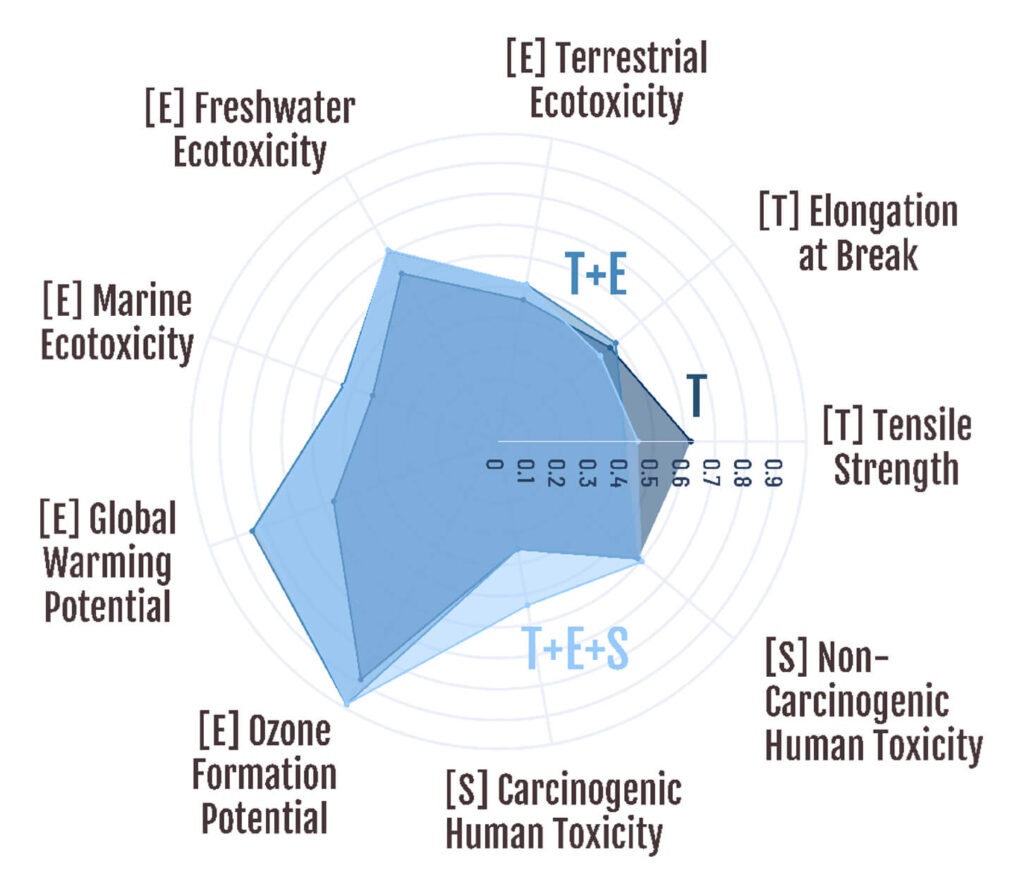
Saal, Hegde, Ortiz, Spero, et al., publication in preparation