Home / Platform / Citrine Catalyst

Citrine | Catalyst: AI Workflow Accelerator

From product goal to AI-guided experimental decisions in minutes

Catalyst helps materials and chemicals teams use natural language to move faster from questions, goals, and data to better experimental decisions.

Built into the Citrine Platform, Catalyst helps scientists query knowledge, analyze candidate experiments, create AI workflows, and improve models with their own domain expertise.

What it is:

It lets product development teams use natural language to move through work that normally takes time, training, and manual setup.

With Catalyst, users can:

  • Query data, uploaded reports, and peer-reviewed scientific papers
  • Analyze suggested experiments and predicted materials
  • Turn product goals into AI workflows
  • Edit AI models with domain knowledge

Catalyst is built into the product development workflow, where Citrine data, models, search spaces, and candidate experiments already live.

What can Catalyst help product experts do?

Gain knowledge and insight

Catalyst helps users query their data, uploaded reports, and curated peer-reviewed scientific papers using natural language.

Teams can find relevant materials, compare options, summarize reports, and reuse prior knowledge faster.

Example prompt:
Which materials have a high viscosity, low cost, and use plant-based surfactants?

Catalyst helps users identify relevant results and inspect the source information behind the answer.

Analyze suggested experiments and predicted materials

Catalyst helps users understand which AI-suggested experiments or predicted materials are most promising.

Users can ask Catalyst to compare candidates, explain tradeoffs, and recommend what to test next based on target properties and customer requirements.

This helps teams move from a long list of possibilities to a focused experimental plan.

Go from product goal to full AI workflow

Catalyst can turn a product development goal into a Citrine project in minutes.

A user can describe a goal in ordinary language, such as:

Find a lower-cost formulation that maintains tensile strength and improves flexibility.

Catalyst can help create the first version of the workflow, including:

  • Dataset
  • AI models
  • Search space
  • Target properties
  • Candidate experiments

The user can then review, edit, and guide the workflow before acting.

Edit AI models using domain knowledge

Catalyst helps product experts add their knowledge directly to AI models using natural language.

For example, a user might write:

Hardness affects texture liking.

Catalyst can suggest model edits that reflect that relationship. The user reviews and approves changes before they are applied.

This helps teams capture expertise, improve model relevance, and make AI workflows more aligned with real product development experience.

How does Catalyst help our customers?

It reduces the time from question to action

Catalyst helps users move faster from product questions to usable next steps.

Instead of manually searching documents, configuring workflows, or analyzing candidates in separate steps, users can prompt Catalyst and work through the process in the platform.

It lowers the barrier to broader AI adoption

Catalyst makes it easier for more scientists to start using AI.

Users can begin with the outcome they want, not with a blank project setup. Catalyst creates a starting point they can inspect and refine.

This reduces training burden and helps teams adopt AI more consistently.

It helps Product Experts choose the next experiment

Catalyst helps scientists understand what has been recommended and why.

Product experts can compare candidates, evaluate tradeoffs, and decide which experiments are most likely to move the project toward its goal.

It supports cross-team learning

Catalyst helps teams reuse knowledge from prior data, uploaded documents, reports, and scientific literature.

It also helps capture domain knowledge in models, making expertise easier to share across teams and projects.

How is Catalyst different from a generic AI assistant?

It is built into the product development workflow

Catalyst works inside the platform, connected to the data, models, search spaces, and candidate experiments that teams already use.

It is designed for product development workflows, not general-purpose chat.

It supports action, not just answers

Catalyst can help users ask questions, analyze data, create workflows, evaluate candidate experiments, and edit models.

That means it supports the work before, during, and after AI-guided candidate generation.

It shows the reasoning

Catalyst is designed for scientific decision-making.

Users can inspect source information, rationale, tradeoffs, and recommendations before deciding what to do next.

Scientific sensibilities

Catalyst is designed for scientific work.

  • It supports expert judgment rather than replacing it
  • It provides references where source material is used
  • It helps users inspect reasoning and recommendations
  • It allows scientists to review, refine, and guide workflows
  • It keeps product experts in control of the final decision

Private and secure

Our security standards apply to your Catalyst queries, just like any other data you trust us with.

Citrine does not train LLMs using your data or conversations.
Information security

What it means for product development teams:

For scientists

Start with the product goal. Query your data and documents. Analyze predicted materials. Review the AI workflow. Decide which experiment to run next.

For R&D managers

Help more team members use AI consistently, reduce repeated work, and shorten the time between project kickoff and experimental action.

For business leaders

Increase product development productivity by helping teams respond faster to customer needs, raw material constraints, regulatory pressure, and changing market requirements.

How it works:

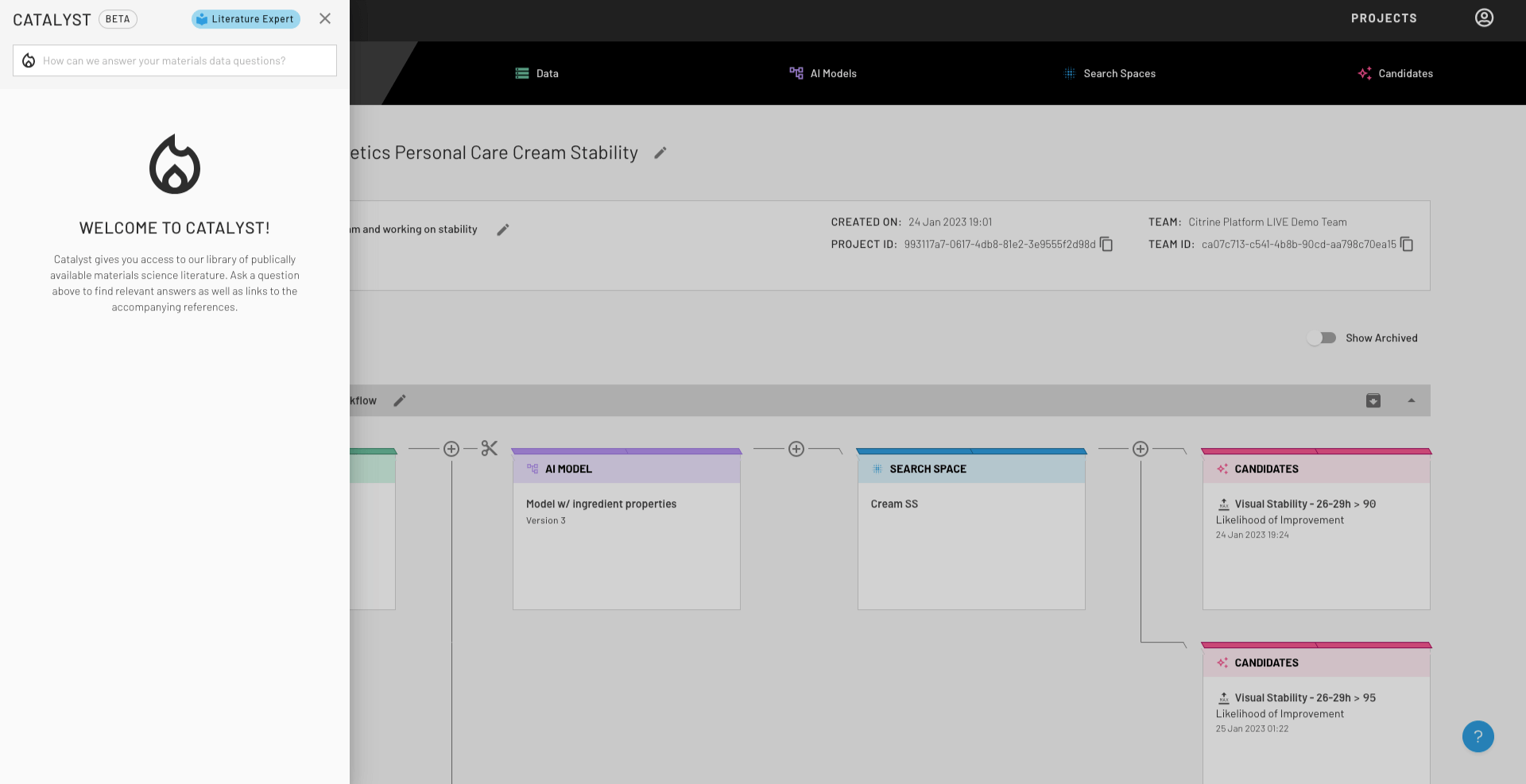
Catalyst is integrated with the rest of the Citrine platform, so you can interact with it as you think of questions or ideas.
Knowledge and insight

Use natural language to query Citrine data, uploaded reports, and peer-reviewed scientific papers.

Experiment analysis

Ask Catalyst to compare candidates, explain tradeoffs, and recommend which experiments to consider next.

AI workflow creation

Describe a product development goal. Catalyst helps create a project with data, models, search space, target properties, and candidate experiments.

Model editing

Tell Catalyst what domain knowledge matters. Catalyst can suggest model edits for the user to review and apply.

See Catalyst in Action:

Move from product goals, questions, and data to AI-guided experimental decisions in minutes.