Solution
AI That Turns Your Data into Better Decisions
Citrine delivers artificial intelligence purpose-built for materials and chemicals innovation: reliably transforming the data you already have into faster, smarter outcomes.
Built for Small, Sparse R&D Datasets
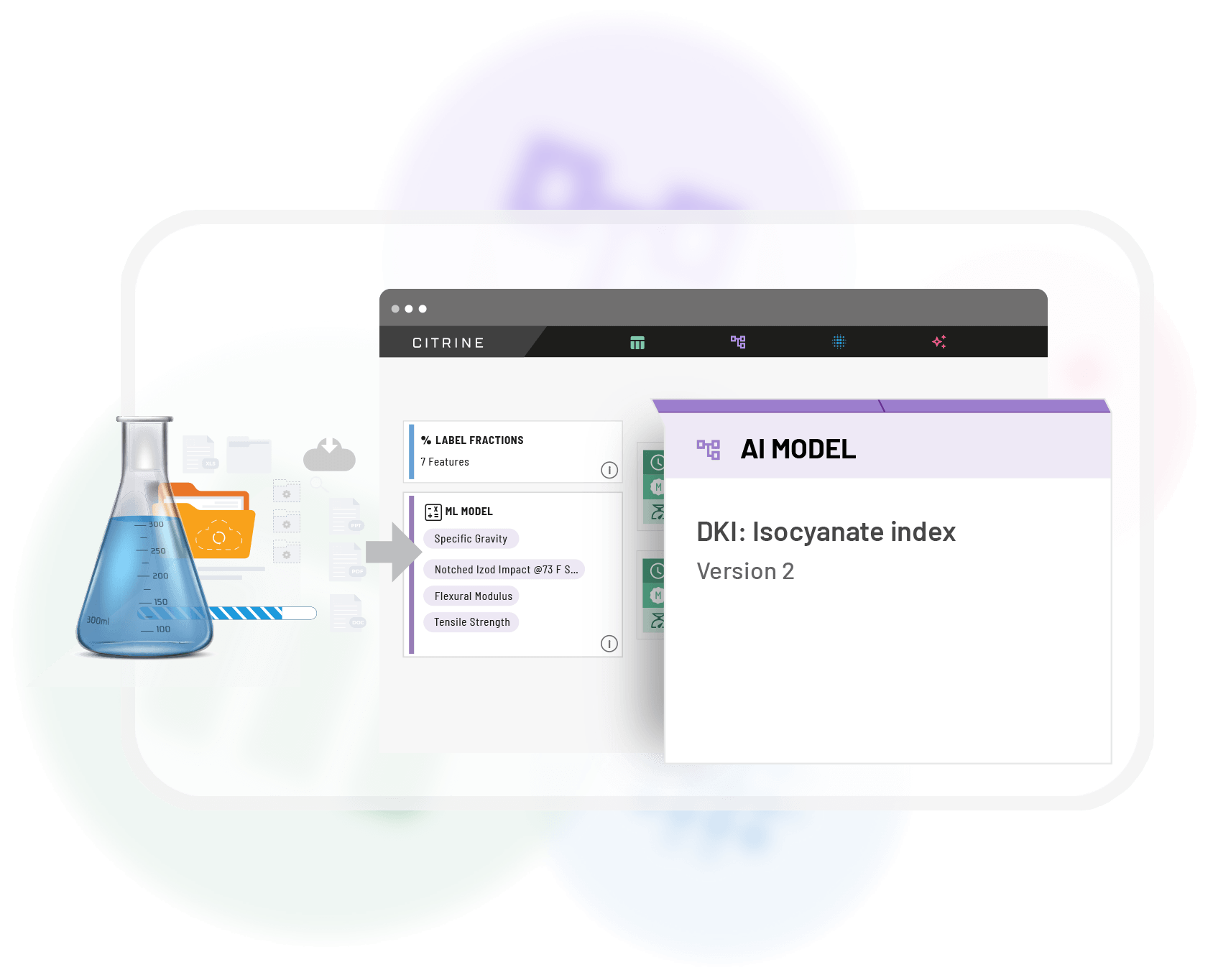
Unlike general-purpose AI, Citrine’s platform is engineered to extract meaningful insights from the limited, unstructured datasets that define materials and chemicals research. This is different from our competitors, who need thousands of data points to get started.
How we do that

Uncertainty Quantification
Estimating prediction uncertainty is key to sound strategic decisions. Citrine pioneered methods for doing this accurately, ensuring customers dramatically reduce the experiments needed to reach their goals.

Integrating Your Expertise
Materials and chemistry are constrained by the laws of physics, economics, and global regulation. Integrating this domain knowledge improves AI models and accelerates development by eliminating impractical options upfront.

Exploiting Relationships
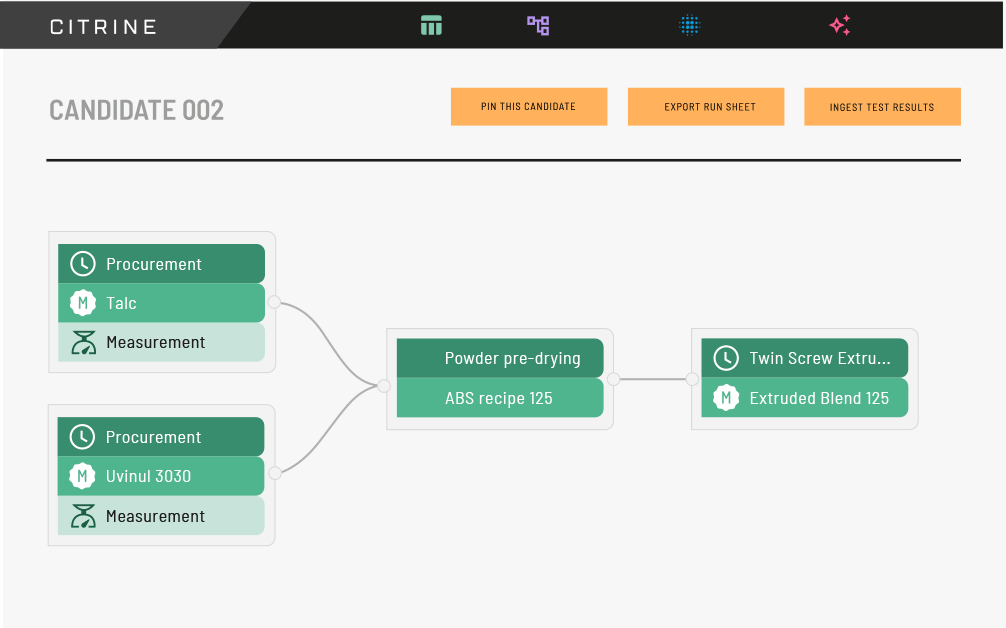
The first thing we learn in materials science is that composition and processing affect structure and therefore final properties. Our data model captures and preserves this type of information and our AI uses it to be smarter.
“The way that you design models through the materials history really reflects the way that experiments are truly done, and I think that that is pretty game changing.”
— Vijay Narasimhan, Director R&D Collaborations, EMD Electronics
Always The Best Model For The Job
AI is a fast-moving field with new models emerging daily. Relying on a single algorithm leaves performance on the table.

No need to chose a model
Citrine’s APEX Industrial Superintelligence automatically runs multiple models and surfaces the most accurate results — no manual tuning required.

Rapid Algorithm Deployment
The architecture supports validation and deployment of new algorithms in days, not weeks — keeping your team at the cutting edge without disruption.

Future-Proof by Design
As the AI landscape evolves, your platform evolves with it: automatically incorporating advances so your competitive advantage compounds over time.
How we maintain our edge
We maintain our technical edge through continuous internal R&D and strategic partnerships with leading universities, government labs, and research institutions. This commitment ensures our platform consistently integrates the latest breakthroughs in AI and data science.
A Tool Worth Using — By Everyone
A tool is worth nothing if nobody uses it. Citrine’s intuitive platform removes every barrier to adoption across your organization.
1.5 Hours to First Model
New users attending a workshop add data and create a working model in just 90 minutes.
— Logan Eby, Chemist – Research and Development, Interplastic Corporation
Guided Workflow
A clear workflow with in-platform help and training gets every team member started quickly.

— Ioanna Tzortzi, Associate Specialist, Application Development, Coating Solutions Business Unit, Perstorp
No Coding Required
No programming or prior data science knowledge needed — designed for scientists and engineers.
— Florian, Application Engineer, Gebrüder Dorfner GmbH & Co.
“The great thing about the platform is you don’t have to be a data scientist to use it. The vast majority of the people using it are just my regular chemists and formulators.”
— David Cranfill, Director of Innovation and Technology, Huntsman Polyurethanes
Proven, Enterprise-Ready
Citrine delivers enterprise-grade capability.
Reusable, Modular Assets
Datasets, AI models, and search spaces become reusable building blocks, compounding your investment across projects and teams.
Information Security
Citrine takes information security seriously. Robust security policies have enabled us to secure ISO 27001 Certification and satisfy the stringent requirements of our customers.
IP
We do not take any stake in the IP produced by our customers when using the Citrine Platform and patent authorities have already clarified that AI cannot hold a patent.
We operate at scale
Pilots are easy. Scaling AI across business units and geographies is where other vendors fail. Citrine customers have already solved the problems others have yet to face.
$ DOCUMENTED CUSTOMER VALUE
TOP SPECIALTY CHEMICAL CO. USE OUR PLATFORM
ACTIVE PROJECTS / MONTH
AI MODELS DEPLOYED ON PLATFORM PER MONTH
Generating Insight
FAQs
-
How does AI work?
There are different types of AI, but at a high level, the machine learning models that Citrine Informatics use essentially look for connections between inputs (raw materials, processing parameters) and outputs (final material properties) and then creates an algorithm to predict the outputs based on the inputs. However, predictions are not as effective if you don’t know how good your prediction is. Therefore, the uncertainty of the predictions is also estimated and this is the extra information that our customers leverage to decide which experiments to take to the lab next.
-
What machine learning techniques are commonly used in materials informatics?
Common techniques include supervised learning (e.g., regression, classification), unsupervised learning (e.g., clustering, dimensionality reduction), and reinforcement learning. Deep learning methods, such as neural networks, are also increasingly used for complex data types like images and simulations, though in most cases the availability of data limits use of deep learning techniques. Citrine Informatics’s sequential learning approach represents a unique optimization framework that is data-efficient and can handle bigger, real-word problems (dozens of variables, multiple objectives, noisy data, and real-world constraints) with ease.
-
What type of AI models do Citrine use?
Citrine uses a new generation of optimization frameworks that build on Bayesian Optimization’s (BO’s) foundations while overcoming many of its limitations. By swapping the Gaussian Process Regression for a more scalable and robust model (random forests with advanced uncertainty quantification), Citrine’s platform retains the data-efficiency and intelligence of BO but gains the ability to handle more challenging, real-word problems (dozens of variables, multiple objectives, noisy data, and real-world constraints) with ease. It provides results that are not only optimal but explainable – a critical factor for trust in AI-driven design in the research community. Different algorithms, such as Gaussian Processes and Random Forests can be used on the platform and the results from the most accurate model will be used.
-
What R2 do you need in your materials AI model?
R2 is a measure of prediction accuracy commonly used to assess model performance. But there are different types of R2. The typical goodness of fit R2 isn’t that useful when trying to push property values beyond the existing training data. Instead we use Predicted R2, or cross-validated R² which estimates how well the model is likely to perform on unseen data. Predicted R2 spans a range from minus infinity to plus one. In the AI-driven experimentation process, a sequential learning approach is used, where you start with small amounts of data and at first use the model not to just predict the properties of candidate materials, but to estimate the uncertainty of the model predictions across the search space. In this way you can carry out experiments in places that look promising in terms of materials properties but where those predictions are highly uncertain. This generates the most valuable data to improve the accuracy of the model so that it can then predict the best materials with more confidence. This approach is counter-intuitive for many researchers, but has been shown to be the quickest way to success. We recommend going to the lab and running the next set of experiments as soon as R2 reaches about 0. We commonly see a reduction in the number of experiments carried out to hit targets of 50-80% using this method. Read more about this in our blog.
-
Why is Uncertainty Quantification important in Materials Informatics?
When a researcher takes an experiment to the lab they hope it will hit their targets, often based on a gut feel for how confident they are that it will be successful. Design of Experiment techniques are often used to plot out a grid of experiments to cover a search space, but these approaches have no idea which experiment will be successful. With Materials Informatics and AI, as well as predicting final material properties, the uncertainty of those experiments is also estimated. The researcher can then decide to take to the lab experiments with a medium certainty of great properties, or a high certainty of mediocre properties or both. The experiments in an area of the search space with high uncertainty are particularly good for generating data that can train the AI model to be more accurate. In this way a researcher can be very strategic and navigate an efficient sequence of experiments to get to target properties using the least time and resource.
-
What is feature importance?
Features are the different kinds of data that you train an AI model on. Feature importance is a way of representing which of these are being used to by the model to predict a final property. For example, if predicting the tastiness of a biscuit, the amount of sugar and amount of vanilla essence might have a high feature importance and the brand of butter used might have a low feature importance. This blog post explains how you can learn from AI models as well as teach them.
-
What is a search space?
A search space, sometimes called a design space, is a representation of all the different allowed options for the combinations of inputs to an AI model. For example, a search space can consist of the allowed ingredients, the allowed processing parameters, perhaps even some rules about which ratios of ingredients are allowed, or how much of one type of ingredient is allowed. Researchers set up search spaces to make sure the AI models are predicting properties of feasible materials, both from a business and physical perspective. Read more about this in our blog.
-
What is transfer learning?
Transfer learning is a machine learning technique where a model trained on one task is adapted to perform a related task. For example, you may know that the fracture toughness of a material is related to its tensile strength. If you have lots of data to predict tensile strength, and not a lot of data to predict fracture toughness, you can model tensile strength and then feed in the predictions of tensile strength into the model predicting fracture toughness. It is also used in raw material substitution. If a model learns that a particular molecular feature is important for predicting a property, it can then predict the performance of a substitute ingredient in the formulation by examining that molecular feature in the new ingredient. In this way, the Citrine platform can predict the properties of new formulations using completely novel ingredients.