Solution
Citrine's Approach to Data
Your AI platform should be ready for your data—not the other way around.
— David Cranfill, Director of Innovation and Technology, Huntsman Polyurethanes
Citrine Data Manager
Citrine Data Manager ingests, harmonizes, and surfaces your experimental and computational data. Your teams can focus on discovery, not data wrangling.
- Ingest and Extract
Four flexible pathways to bring data into the platform quickly - Harmonize
Automated normalization that breaks down silos securely - Explore
Filter, search, and visualize to uncover actionable insight
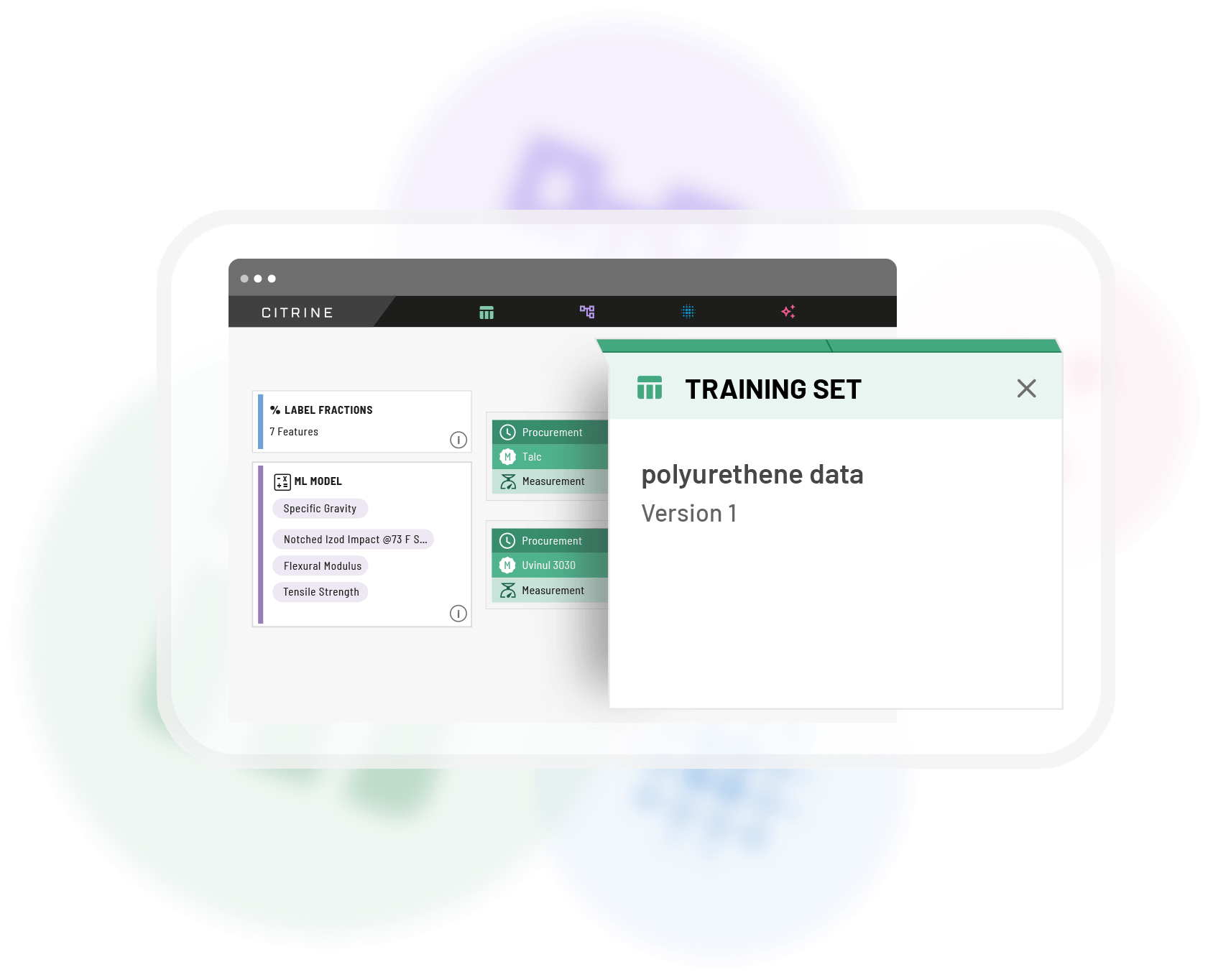
Benefits
Unlock strategic advantages across your organization with a robust data management foundation.
Facilitate onboarding
Accelerate new team member integration with interactive materials data history, enabling rapid product understanding and project ramp-up.
Improve sales
Empower sales teams with deep insights from data and visualizations, enabling superior technical service delivery and data-driven product recommendations.
Accelerate development
Preserve full data provenance and critical property-structure-process relationships, catalyzing advanced AI development for materials and chemicals.
Rapid Data Ingest – Four Pathways In
No matter how your data lives today, in spreadsheets, instrument files, or legacy databases, Citrine offers four distinct routes to get it into the platform quickly and accurately.

Omni
The universal data harmonizer. Upload existing files, map your data automatically, product expert validates data.

Excel template
Structure your data into a simple, pre-configured Excel template and upload it directly.

API integration
Citrine Data Engineers advise on seamless integration via the API, connecting your existing systems and workflows to the platform.

Citrine data services
Our chemically trained data experts partner directly with your team to ingest complex or unstructured datasets with domain precision.
Seamless & Secure Harmonization
Data silos slow discovery. Citrine Data Manager automatically harmonizes disparate datasets into a single, queryable source of truth, without compromising security or team autonomy.
Flexible Access & Governance
 Granular controls on team authorization and dataset separation or pooling. Data can be shared or secured according to your organization’s policy.
Data Vocabularies and Units
 Ensure all data representing the same property are pooled and normalized consistently—no manual mapping required.
Product experts keep working in their preferred units. The platform handles conversion behind the scenes so standard practice stays intact.
Filter, Search & Visualize
Once your data is harmonized, powerful exploration tools help you generate insight faster, turning raw measurements into actionable intelligence for your R&D teams.
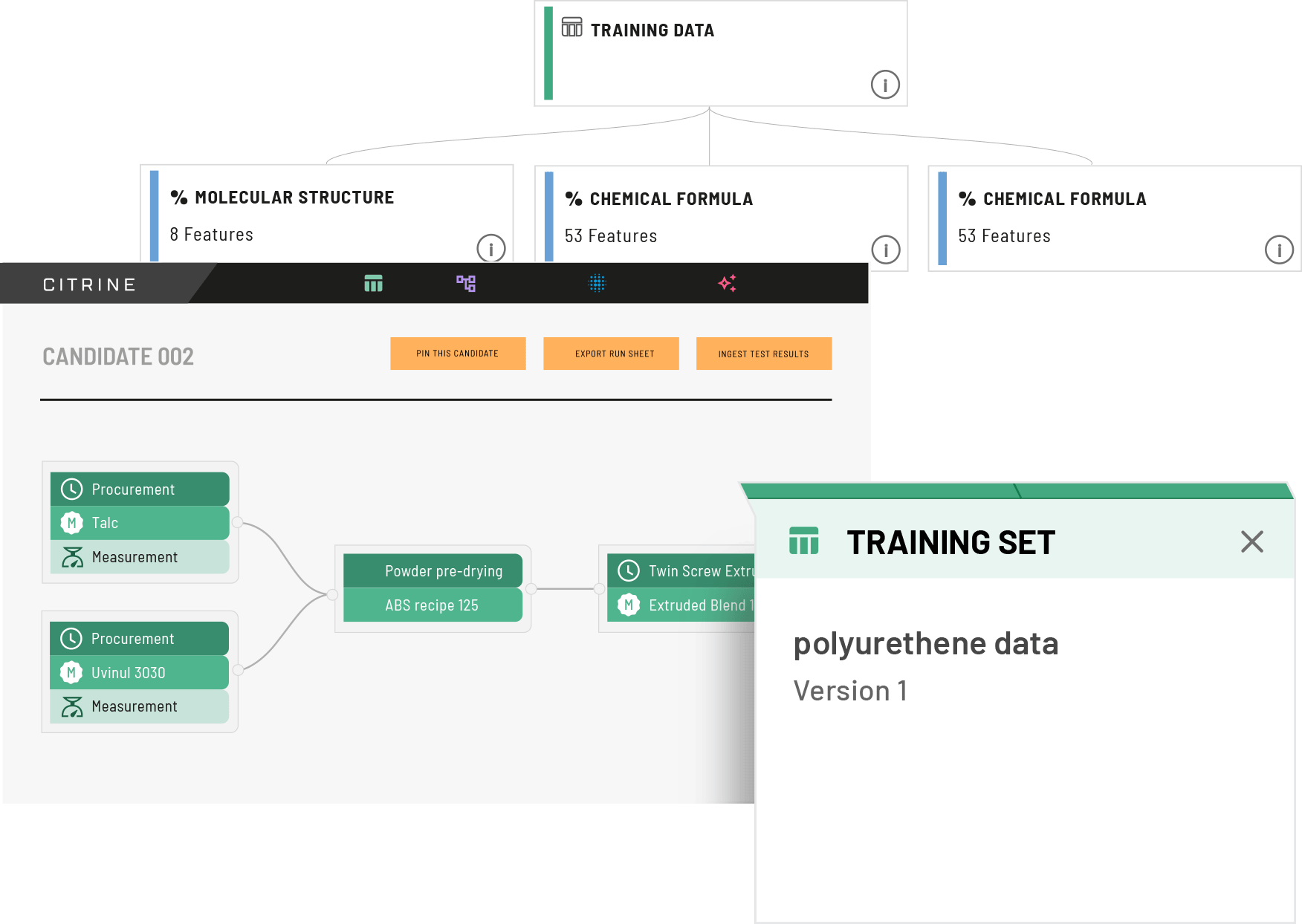
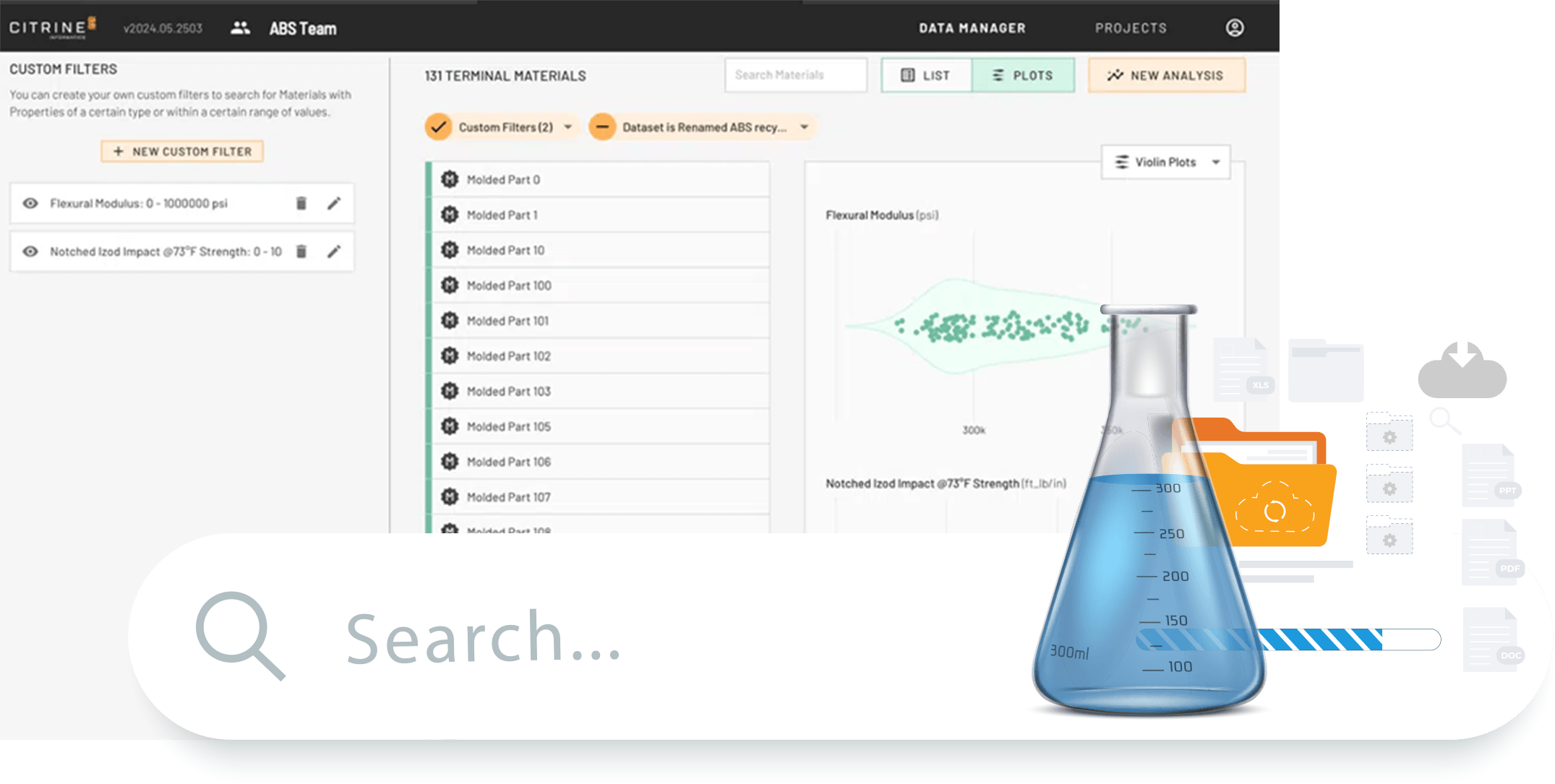
Find what you need
Filter by properties and tags, or search by name, to locate the exact material or formulation you’re looking for. Instantly.
Spot gaps & trends
Visualize property distributions to identify bad data, understand coverage gaps, and plot charts revealing relationships between structure, composition, processing, and performance.

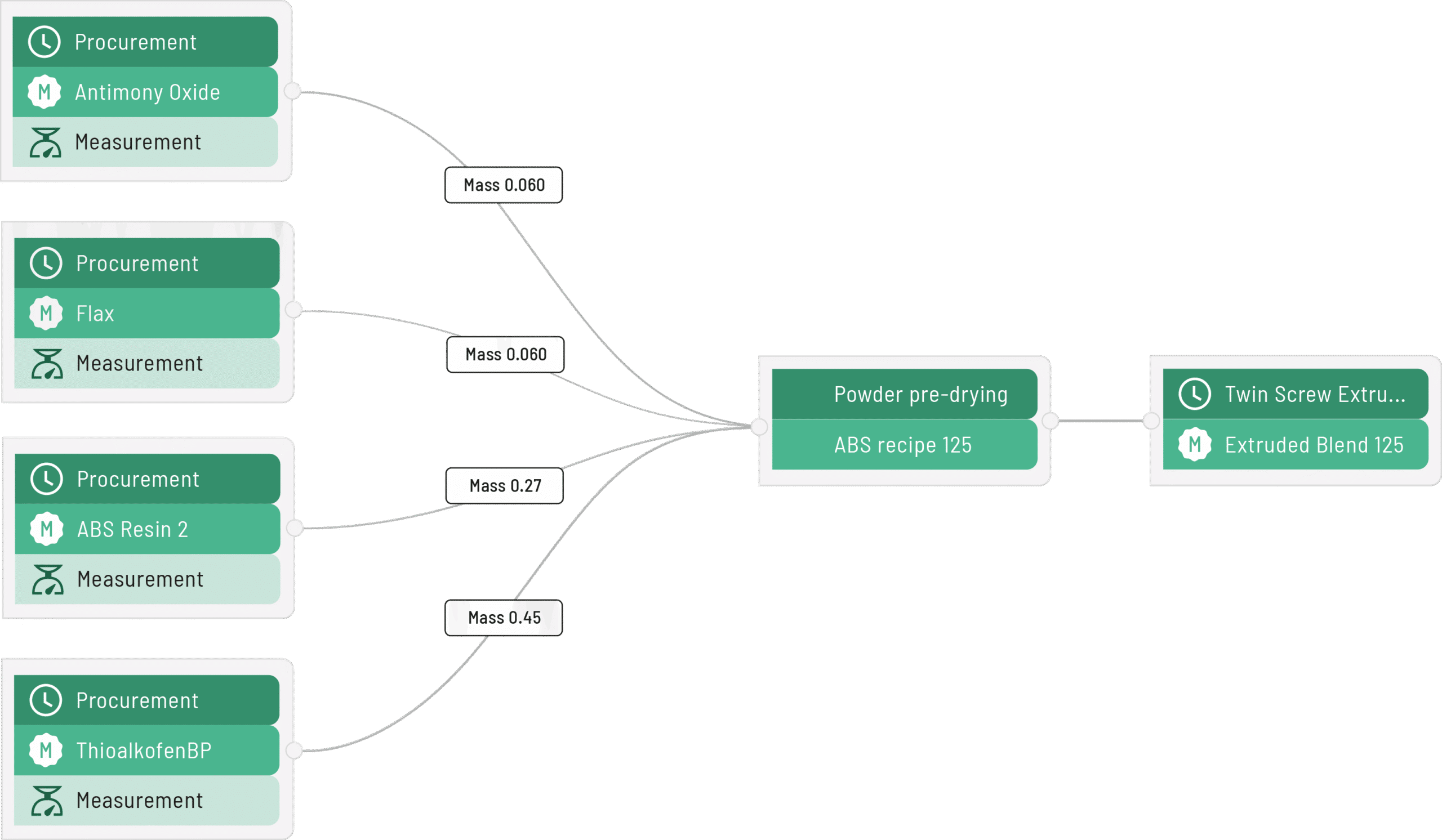
Interactive material history
Intuitive, interactive diagram conveys how a material is created and helps new employees get up to speed quickly.
Citrine’s Data Model — Built for Materials People
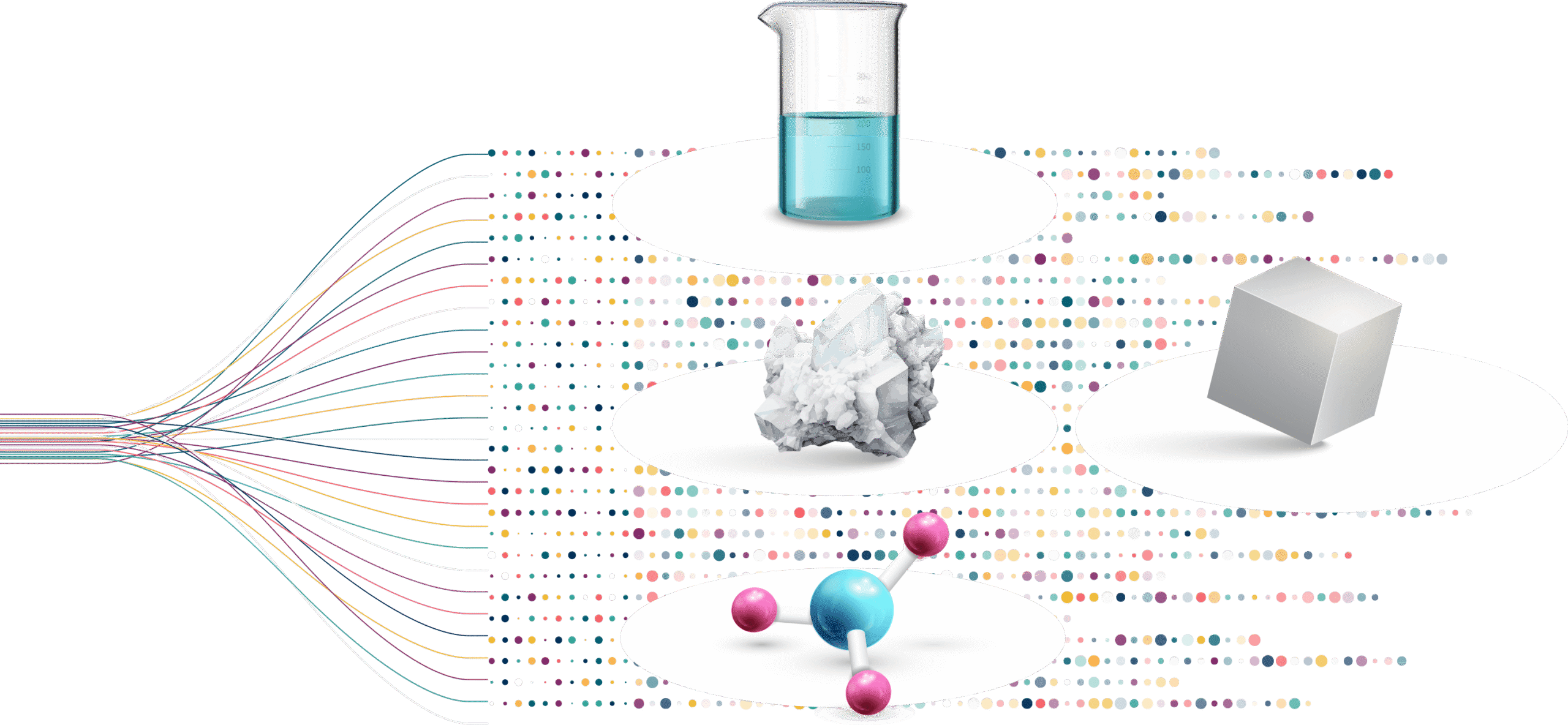
Created by materials scientists for materials scientists, Citrine’s data model underlies the Citrine platform. It fully represents materials, chemicals, and the processes that produce them.
Domain native
Captures materials, chemicals, and their full processing history in a single, coherent structure.
Infinitely scalable
A flexible, scalable data model that grows with your research.
Filter, Search & Visualize
Once your data is harmonized, powerful exploration tools help you generate insight faster, turning raw measurements into actionable intelligence for your R&D teams.
Find what you need
Filter by properties and tags, or search by name, to locate the exact material or formulation you’re looking for. Instantly.
Spot gaps & trends
Visualize property distributions to identify bad data, understand coverage gaps, and plot charts revealing relationships between structure, composition, processing, and performance.
Interactive material history
Intuitive, interactive diagram conveys how a material is created and helps new employees get up to speed quickly.
Citrine’s Data Model — Built for Materials People
Created by materials scientists for materials scientists, Citrine’s data model underlies the Citrine platform. It fully represents materials, chemicals, and the processes that produce them.
Domain native
Captures materials, chemicals, and their full processing history in a single, coherent structure.
Infinitely scalable
A flexible, scalable data model that grows with your research.
FAQs
-
What types of data are used in materials informatics?
Data used in materials informatics can include experimental measurements, computational simulation results, images (such as micrographs), text (such as research articles and datasheets), and other forms of structured and unstructured data related to materials and chemicals.
-
How much data do you need to get started with AI for materials and chemicals?
While it is true that more data is better, it is more important that the data is diverse, showing failures as well as successes and covering the whole search space. We can start using AI with 12 data points, 30 data points is a solid start, 100 data points is great. (A data point = an experiment (formulation data + processing parameters + final material properties).
-
How does Citrine keep customer data secure?
Citrine Informatics is ISO 270001 accredited. You can read about data security in detail here. In summary, each customer has their own encrypted instance of the platform, and only they can access their data and their models. Data and models are not shared across customers and even Citrine employees need permission from customers to access their data when helping them on projects.
-
How does materials informatics handle the complexity of materials data?
Feature engineering is used to distill complex data into manageable and insightful forms. Feature engineering is the process of deciding which bits of information could be useful to a model in predicting the properties of interest and getting them into a format that maximizes a model’s ability to learn. Domain knowledge is crucial for this process. While many features in materials and chemicals can be generated quite easily by converting molecular structures and chemical formulas into more detailed representations, there are often nuances that are best leveraged by letting domain experts (those that know their process better than anyone) break down what’s actually important. It is also key to have systems that can record all the conditions at play during sample preparation and record process steps and their parameters as well as ingredients and their amounts.
-
What is featurization?
Featurization is the process of transforming raw data into a format that can be used by machine learning models. This involves extracting meaningful features or characteristics from the data that capture the important aspects needed to predict a property of interest. In the context of materials science or chemistry, featurization can involve the process of converting molecular structures into data such as the molecular weight and number of hydrogen bonds, or distilling charts into data representing features such as peak values.
-
What are SMILES and InCHI, and how are they used on the Citrine Platform?
SMILES (Simplified Molecular Input Line Entry System) and InCHI (International Chemical Identifier) are notations used to represent the structure of chemical molecules in text format. It provides a way to encode molecular structures using short ASCII strings, which makes it convenient for inputting chemical information. In the Citrine Platform these are automatically converted into extra data about the molecule to feed into the AI model. For example, if you know the SMILES string you can automatically calculate the number of hydrogen bonds. The platform can automatically convert these strings into over 100 different features for each molecule proven to impact predictions across domains. These include surface properties, reactivity, polarizability etc.
-
What is data ingestion?
Data ingestion refers to the process of collecting, importing, and processing data for use in a data system or application. In the case of the Citrine Platform this can be done by uploading an excel spreadsheet or by creating data pipelines directly from your data systems.
Ready to put your data to work?
Citrine meets your data where it is — so your teams can focus on what matters: accelerating materials innovation with AI.