
Materials and chemicals product-development teams are being asked to reach demanding property targets while managing cost, supply risk, regulatory pressure, and limited lab capacity. Many leaders see AI as part of the answer. Yet some programs spend months preparing for AI without changing a single experimental decision.
The delay often comes from three reasonable assumptions: the data must be perfect, the model must be highly accurate, and unsuccessful experiments should be avoided. Each assumption reflects scientific discipline. Each can also slow learning when it becomes a condition that must be satisfied before the team acts.
Citrine customers currently work on 400 projects, deploy 600 AI models, and generate 70,000 experiment suggestions on the platform each month. Across that activity, different teams bring different data landscapes, experimental habits, and attitudes toward uncertainty. The teams that realize value sooner tend to make three mindset shifts.
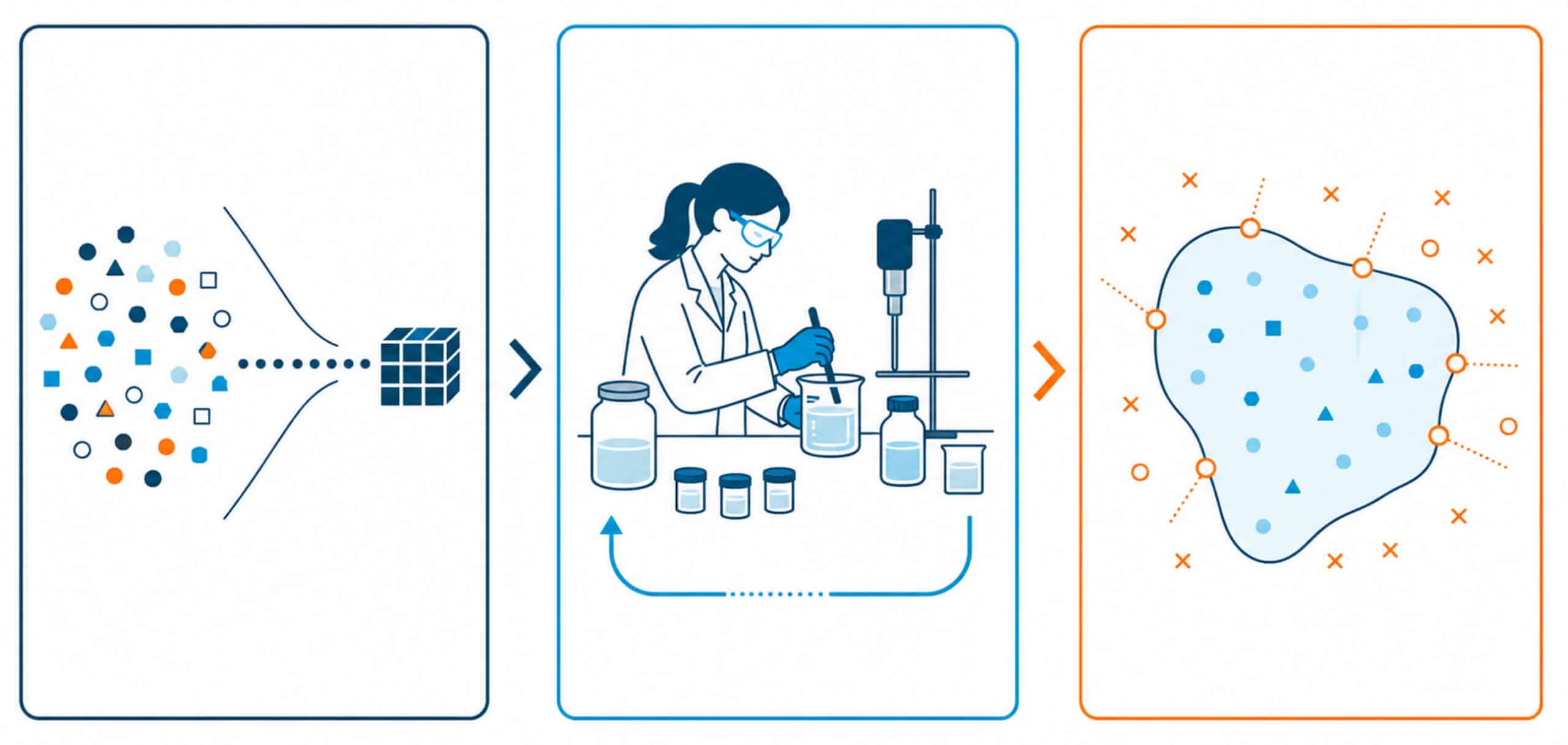
1. Begin with useful data, not a finished data lake
A common AI readiness plan starts with an enterprise data project. Historical experiments must be collected, every naming convention resolved, units standardized, and every record cleaned before scientists can train a model.
Some foundational work is necessary. The problem is treating comprehensive curation as the price of entry.
Historical laboratory data is rarely uniform. Conditions may be missing. Test methods may have changed. Formulation names may mean different things across teams. Many records may also describe mature products rather than the next high-value problem the business needs to solve. Applying the same curation effort to every record can consume years without revealing which data will improve a product-development decision.
Huntsman’s experience illustrates the value of beginning without an exhaustive data lake.
David Cranfill, Technology & Innovation Director at Huntsman Polyurethane, said, “The thing that I liked about Citrine is you don’t need a huge amount of data to get started.”
Huntsman Building Solutions later reduced starter formulation creation time from a few months to less than one day using Citrine.
A smaller, more targeted start changes the sequence. Choose one important formulation problem. Identify the target properties, constraints, and experiments the lab can actually run. Then assemble a relevant, diverse starting dataset. As few as 30 well-chosen data points can provide a practical foundation for an initial model and a first group of experiment suggestions.
The first model becomes a diagnostic tool for the data strategy. It shows where the team has coverage, where uncertainty remains high, which variables appear informative, and which missing information matters to the next decision. The organization can then invest in the data that proves useful through application.
The leadership question is straightforward: what is the smallest body of relevant evidence that allows this team to make a better experimental decision now?
2. Experimental iteration is the fastest way to improve your models and results
Once a model exists, teams can fall into a second delay. They keep refining algorithms, adding features, and improving a familiar model score before they trust the system enough to run new experiments.
The key is not to build the perfect model that can predict all of your data right now. You haven’t measured every material and you never will. The goal is to create a model that will learn about your system and be helpful in predicting how never-before-seen materials might perform. Build a model that captures some insights and can leverage its own uncertainty to guide your next experiments to be as efficient as possible.
Scientists rarely need the model to predict every possible response with equal precision. They need it to identify promising trade-offs, express uncertainty, and help them select a more informative next group of experiments.
New experimental data is especially valuable because the team controls it. Scientists can document the conditions, use the current test method, explore properties that matter to the active project, and deliberately sample regions where the model is uncertain. Uploading this data and retraining the model will usually improve model accuracy much more than feature engineering.
This creates a sequential learning loop:
- Train a model using the available data.
- Identify promising and uncertain parts of the design space in the area of interest.
- Select a balanced group of experiments.
- Run and document those experiments.
- Add every result to the dataset.
- Repeat with better evidence.

The first round may not hit every target. AI is not magic, and an early model has limited evidence. Yet that round can reveal the boundaries of feasible performance and sharpen the next recommendations. The second and third rounds become more focused because they build on controlled, relevant observations.
This is the tortoise-and-hare lesson of AI-guided experimentation. A team that enters the lab early may appear to accept more uncertainty at the start. Across the full program, it can reach the target profile with fewer iterations because each round is designed to reduce the uncertainty that matters.
One Citrine user reported reaching all target properties after two rounds of sequential learning while also capturing precise knowledge about how components affected final properties. The useful outcome included both the formulation and a clearer map of the design space.

3. Treat failed experiments as valuable boundary data
Scientific training encourages careful preparation, controlled conditions, and reproducibility. Those disciplines remain essential. Product development also benefits from an engineering habit: learn deliberately from prototypes that do not work.
An AI model learns from the examples it receives. If the dataset contains only successful formulations, the apparent feasible region becomes too large. The model has little evidence about phase separation, porosity, impurities, mechanical failure, unacceptable viscosity, infeasible processing, excessive waste, or prohibitive cost. Recommendations may look attractive numerically while repeating practical mistakes that experienced scientists already know to avoid.
Documented failures define the boundary. They show which combinations are unstable, which processing windows are too narrow, and which trade-offs cannot be ignored. With that evidence, later recommendations can account for feasibility as well as technical performance.

The distinction is documentation. A result labeled only “failed” has limited value. The team should record what happened, under which conditions, how the failure was measured, and whether the outcome was caused by the formulation, process, equipment, or test method. That converts a disappointing batch into reusable knowledge.
Leaders can reinforce this behavior by redefining a successful experiment. A useful experiment improves the product or improves the next decision. It tests an important uncertainty, captures its conditions clearly, and gives the next model more evidence about where to search or where to stop searching.
A practical starting pattern
These mindset shifts can be translated into a focused first project:
- Select one commercially meaningful formulation decision tied to customer response, technical performance, cost, supply resilience, or a regulatory need.
- Define the property targets, business constraints, and experiments the lab can run.
- Assemble a small, relevant, diverse dataset.
- Train an initial model and use uncertainty to select a mixed group of exploratory and performance-oriented experiments.
- Return to the lab quickly.
- Add successful and unsuccessful results with the same documentation discipline.
- Measure progress through the number of iterations and experiments required to reach the target profile, alongside the learning captured for future projects.
This approach also changes the role of leadership. VP-level R&D leaders need to protect time for scientists to learn a new workflow and reward evidence gained through iteration. Business unit heads need to tie the first application to a visible business decision, then fund broader data work based on what the project demonstrates.
The data does not need to be perfect before learning begins. The model does not need to predict the entire design space perfectly before it improves the next experiment. An unsuccessful experiment does not have to be wasted effort.
Teams create value from AI when they shorten the distance between evidence, experiment, and decision.
Learn from a decade of practical application
Citrine Informatics is the proven AI platform for materials and chemistry product development. Ten of the top 20 specialty chemical companies have trusted Citrine, and customers have created hundreds of millions in documented value using the platform.
From lab to launch, faster.
Contact Citrine Informatics to learn more from our experience supporting product-development teams as they adopt AI-guided experimentation.